Cart
0
You May Also Like:
-
What Should You Consider Before Ordering Custom Medals in Bulk?
-
The Art of Crafting Designer Trophies – A Step-by-Step Process
Custom sports medals are made specifically for an event, team, or organisation—often featuring names, dates, logos, or unique artwork—while generic awards are mass-produced and designed to suit “any” competition. That difference becomes obvious the moment medals are presented: custom pieces feel personal and memorable, while generic options can feel interchangeable.
For many organisers, the decision isn’t just about appearance. It’s about what the award communicates. A tailored medal signals that the event matters and that participants’ effort deserves more than a standard catalogue item. That’s why brands like Kingdom Pins see strong demand from schools, clubs, and event organisers who want their awards to feel meaningful and worth keeping.
What’s the Real Difference Between Custom Medals and Generic Awards?
The biggest difference isn’t that custom medals are “stronger” or “shinier”—it’s that they’re event-specific. A custom medal can capture the identity of a tournament, the values of a club, or the story of a community event in a way generic awards simply can’t.
Custom sports medals commonly include event details such as the competition name, year, category, sponsor logos, or location. Generic awards usually feature the same stock sporting icons and shapes, with little or no connection to the moment being recognised. Over time, this changes how recipients value what they’ve been given. A personalised medal becomes part of someone’s story; a generic award often blends into the background.
When Are Custom Sports Medals the Better Choice?
Custom sports medals are usually chosen when an organiser wants the award to act as both recognition and a keepsake. They’re especially common when the event has identity, tradition, or high participation—anything where the experience matters as much as the result.
Custom medals are a strong fit for:
-
Annual competitions where the year matters (school sports days, club championships, league finals)
-
Branded events such as charity runs, fun runs, corporate sports days, surf lifesaving carnivals, and community tournaments
In these scenarios, medals aren’t only about “who won.” They help build pride, boost participation next year, and give people something they’ll actually want to display.
When Do Generic Awards Still Make Sense?
Generic awards can be the practical option when speed and simplicity matter more than storytelling. If the event is small, last-minute, or informal, off-the-shelf medals or trophies can cover the basics.
They’re commonly used when budgets are extremely tight, timelines are short, or the organiser needs a quick solution for a once-off activity that won’t be repeated. For some events, that’s perfectly fine—especially when the focus is participation rather than presentation.
Why Do Custom Medals Feel More Meaningful to Recipients?
Custom sports medals create emotional value because they anchor the achievement to a specific moment. Seeing a date, event name, or familiar logo makes the award instantly recognisable years later. That’s what turns it into a keepsake rather than a generic object.
Recipients also tend to share custom medals more—on social media, in team group chats, or displayed at home—because the award visually represents their event. For organisers, that adds an extra benefit: custom sports medals quietly extend event branding long after the finish line.
What Can You Customise on a Sports Medal?
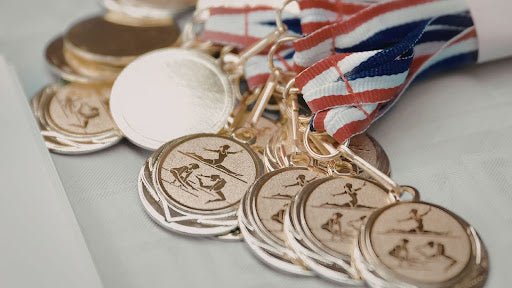
A major advantage of custom sports medals is that you can match the award to the sport, audience, and event vibe—whether that’s premium and formal or colourful and fun. Common customisation options include medal shape, size, metal finish, ribbon colours, and artwork on both sides, with optional engraving for names or categories.
This is where secondary factors matter too, such as medal thickness (heavier medals feel more prestigious), whether you want a 3D relief look, or if the event needs a consistent “gold/silver/bronze” set for podium finishes.
Are There Downsides to Custom Medals?
The two main limitations are planning and budget. Custom medals require design approval and production time, so they work best when an organiser can plan ahead. They can also cost more upfront than generic awards—especially for smaller quantities—because you’re paying for custom artwork and manufacturing rather than mass stock.
That said, the trade-off is usually worth it when the event is recurring, brand-driven, or emotionally important. A medal that participants value can strengthen retention and reputation, which often matters more than saving a small amount per unit.
Conclusion
Custom sports medals are typically used instead of generic awards when the event deserves recognition that feels personal, branded, and worth keeping. They’re the preferred choice for school competitions, club championships, charity runs, corporate events, and milestone tournaments—anywhere the organiser wants the award to reflect the experience, not just the outcome.
If you’re planning a sports day, fun run medals, tournament medals, team awards, or championship medals, custom options deliver a more memorable result than generic alternatives ever can.